Sunday, December 20, 1964 was a red-letter day in Alto. No more “Number Please”. No more “That line is busy”. No more “She’s not home. I just saw her going in the drug store”. Alto was joining the 20th century. Alto was going “dial”.
The dial telephone was invented before 1900 by a funeral director whose calls from bereaved families were being hijacked by a competiing undertaker whose wife worked at the telephone office. However the system was not in general use until about the 1940’s.
By 1962, the Alto City Council decided it was time to upgrade. They informed W E Bynum who,with his sons Marshall and Edward, had been running the Alto Telephone Company since 1920, that when the franchise ran out in 1964 it would not be renewed unless a dial system was added.
In May 1963, the Bynums sold to Lufkin Telephone Exchange and the next month the franchise was renewed. W E Bynum chose to retire but Marshall and Edward continued to run the company after the sale.
In a front-page tribute to Mr. Bynum in the July 11 1963 issue of the Herald, Inez Schochler Turner, a former telephone operator says “The first remembrance I have of the telephone company was when it was located above Thomas Hardware…. It was not unusual for one of the operators to lean out of the upstairs window and yell to someone on the street to ‘Go answer the phone’”.
Mrs. Turner continues: Mr Bynum employed quite a number of people in the office and outside, but he worked right along beside them, building lines, digging post holes, cutting brush, even working the switchboard as an operator and repairing it when needed.
Alto had telephone service long before the days of the Bynums. In fact, in 1908 there were 2 companies competing for telephone customers. The first mention is in March 1908, when L L Cole, manager of Alto Telephone Company offered a $50 reward for arrest and conviction of anyone found tying Alto Telephone lines to Farmers’ Union lines.
Apparently telephone lines were strung up to anything that was handy. In an comment in September 1908, editor McClure remarks that it is almost a sacrilege to mutilate beautiful shade trees to accommodate telephone wires.
One extra bonus of the early-day telephone was offering employment for women, especially young women. Numerous wedding stories in the Herald identify the bride as a former telephone operator. In 1910, though, a one-time advertisement asked for a “bright intelligent boy 12-15 years old to learn to operate the switchboard”. It would be interesting to know how that experiment worked out.
There were a few drawbacks to the dial system. The Fire Department, which had depended on telephone operators to ring the fire whistle had to put in an automatic system to dial phones of designated volunteers instead. And Mrs Viola Scales of the Linwood community reported a feeling of sadness at knowing she would no longer hear the friendly voices of the operators.
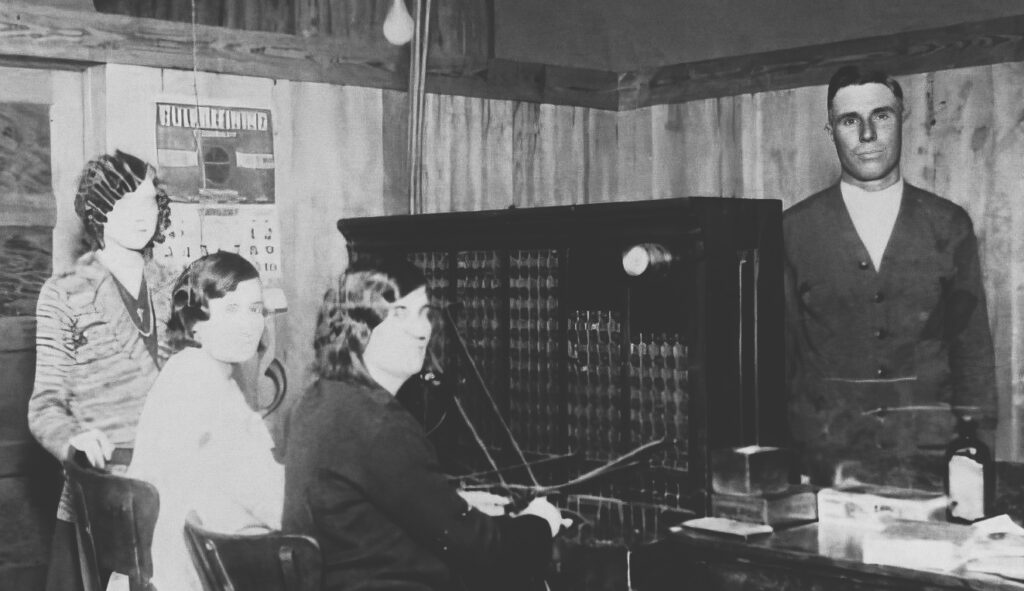
The photo at the top of this column, like most of the photos I use, comes from the outstanding Stella Hill Library archive of historical photos. There’s a link to the archive just below.
Here is the attached caption: “Alto Telephone Office 1920’s The string barely visible between the two women on the left when pulled would activate the fire whistle. W E Bynum, owner, and his women operators. The phone company was locally owned until the 1960’s.”